




RevHI at 20: Revolution Hawaii Shapes Young Adults for Two Decades
“The idea for the program was to be discipled and to live it out. Love God with all your heart, soul, strength and mind. Love your neighbor as yourself within the community of Hawaii.”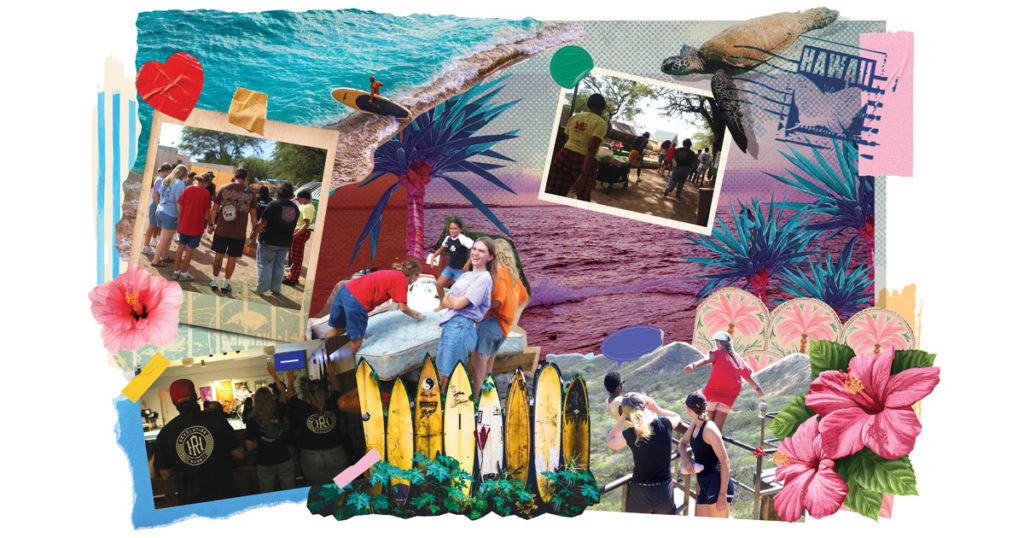
When I arrived at Camp Homelani on Friday morning, I immediately went to sit in on the daily young adult Bible study, which follows personal devotion time. As I listened to their conversation and looked around the room, I noticed dog-eared Bibles and worn notebooks. This group of young adults was committed to personal Bible study. They were also committed to reciprocal discussion, with more back-and-forth than one might expect from a young adult Bible study. The discussion changed, and I was shocked to hear the group confront interpersonal issues. No one was upset, and they resolved the issues amicably. It was beautiful to watch this group heal and grow together in real time. They closed their discussion in prayer, holding hands in a circle. As they stood to leave, one girl asked their leader, “Can we worship again?” A resounding cry of “Yes!” filled the room, and they gathered again outside with a guitar to sing praise together.
This was my introduction to Revolution Hawaii (RevHI), a gap-year discipleship program operated by The Salvation Army Hawaiian and Pacific Islands Division (HIPAC) on Oahu. In RevHI, young adult Salvationists, Christians from other denominations and sometimes people with little to no faith spend a year learning how to get close to God and be His hands and feet via ministries throughout the Hawaiian Islands. The 2025-2026 session is RevHI’s 20th year of ministry and discipleship.
Rob Noland, director of both RevHI and Camp Homelani, felt called to young adult discipleship long before starting the program. When he was running a corps plant in Waianae, he and his youth pastor, Garrett, constantly discussed discipleship and missional work. They held church meetings in parks and tents and had a healthy community of young adults who loved what they were doing and wanted to be involved. It was Rob’s goal to figure out how he could make that happen. “I never really was discipled in a way that I wish I was,” Rob said. “I realized that young adults are looking for that, too. They’re looking for that real experience.”
The divisional commander (DC) asked the Army’s young adults, including Garrett, to pitch him ideas for new programs and ministries, daring them to make him say no. Garrett got Rob involved, seeing this as their chance. They’d been regularly attending interdenominational conferences, where inspiration struck for their pitch to the DC: they heard about a program operating out of inner-city Philadelphia called “Mission Year,” where 18–29 year-olds spent a year living in that community, learning to love God and love their neighbors. Why couldn’t The Salvation Army do something similar?
After much prayer over the concept, Rob was separately approached by both the Hawaiian divisional youth secretary and the western territorial youth secretary with the same idea: missional young adult discipleship in Hawaii. Rob and Garrett saw these meetings as confirmation that the idea was coming from God and went to pitch it to the DC with full confidence. The DC seemed to like their pitch, but then nothing happened.
A couple of months later, when Rob thought the idea had been forgotten, the DC took him and his wife out to dinner. Before they’d even sat down, he told Rob the territory loved the idea and wanted to support it. He spent the next year researching discipleship programs and crafting what would become RevHI, with the first session starting in 2005-2006. Those first few years were a learning experience, building the plane as they flew it, but support from leadership and a solid foundation for the mission kept things steady.
“The idea for the program was to be discipled and to live it out. Love God with all your heart, soul, strength and mind. Love your neighbor as yourself within the community of Hawaii. That’s the great command, right?” Rob said. “They spent their time outside of the corps, knocking on doors, going to the parks and building relationships with the unhoused, and then bringing that connection back into the corps. That was our vision.”
Over the following 15 years, RevHI continued to change as it grew, adding on more support staff and bringing in bigger sessions. At first, they had young adults from every division in the western territory. Then the other American territories. Then Canada and Australia. Then Japan, Korea, Spain, Russia, Brazil and more. They now have their biggest session since COVID-19, with 13 young people, including two from the UK and two from Australia. “Every year we’d relook at what we did, change things, make it better. It was going well. We were seeing great results.”
Rob says that team members return to their corps on fire and ready to get involved, and some have even gone on to officership. It’s easy to believe him, given all that I saw the current team experience in just one week of discipleship. “If it wasn’t for RevHI, I probably wouldn’t be on track to officership,” said Kivo “Manu” Ide, a second-year cadet at The Salvation Army’s College for Officer Training. “If it wasn’t for the opportunities RevHI gave me to do hands-on ministry, I wouldn’t be where I’m at today, honestly.”
“We show you how to live this life and follow Jesus, then go home and put it into practice and disciple others,” Rob said. “The lesson I’m learning is that I need to be continually dependent on God. But it’s cool to see Him keep coming through.”
On my first day with RevHI, the team traveled to Waianae, where they make regular visits to “the bush,” a self-governed unhoused encampment. They started with a group prayer and then ventured into the city of tents and makeshift shelters to deliver snacks, baked goods, clothes, diapers and love to the people of the bush. With their weekly visits, the RevHI team has cultivated authentic relationships with the residents there and looks forward to seeing them. “There’s not a lot of love for the unhoused. These people are going through such tough, difficult situations, and there’s not a lot of places they can go,” said Micah Mitchell, 20, who came to RevHI from Southern California. “I’ve learned that you can’t just throw money at those issues, you have to throw time and love at them.”
Later that day, the team played games with children coming home from school. “They need someone that’s going to show up for them, someone that’s going to go to bat for them, love on them, no matter if they’re at their lowest or highest,” said Micah. “[It’s] not just looking at people, giving them a sandwich and walking by, but actually investing time into them. Letting them know that they’re worth that time.”
Sunday afternoon, RevHI went to the Kauluwela Mission Corps in Honolulu to lead Upper Room, an evening church service with a more relaxed, unstructured vibe. Before the service, the team met to pray. One member picks a topic, then they spend 15 minutes praying individually. After the opening prayer, the room was filled with mutters and whispers of conversation with God. Fifteen minutes of ceaseless prayer was easy for them. One unhoused man arrived early, eating pizza and quietly reading a songbook, then a “War Cry,” then a Bible as the room was suffused with prayer.
The prayer time ended, and the team split up. Some team members went to “search for some friends,” bringing people off the street to Upper Room. The rest were tasked with setting up while a select few prepared to lead worship with the praise team on piano, drums, and on the mic. The service started, and immediately the atmosphere was different from what I expected. People milled about casually as everyone sang, wading through worship. Children laughed and played up and down the aisle.
Anastasia, a team member from Australia, led a time of popcorn testimonies. One man stood out, sharing his gratitude for RevHI’s ministry to the unhoused community; he himself had been unhoused only three weeks prior. Then, team member Clara gave a written testimony at the pulpit — one of at least two stories every team member is required to write about their time in the ministry, how they see and experience God working in their lives. Next, a short message was followed by more praise and worship to end the service, but the attitude of worship lingered.
“Upper Room really changed my perspective on what worship looks like,” said Sthefania Mihilli, RevHI’s female resident assistant and former team member. “Every single person in there has their own story, has a whole different reason why they’re worshiping. As much as I love to worship, I think Upper Room is a place where I really just love to sit back and observe and watch everybody remember the Lord and praise Him for where He’s got us all today.”
The sun went down, and the team spent the next hour making peanut butter and jelly sandwiches and brewing coffee in the corps’ basement while they laughed and listened to blaring music. It was all too easy to get caught up in their energy, even when doing something so mundane. When they finished, they split into two teams and hit the street, making friends and offering food. Maya Morrow, 19, from San Jose, described the feeling the ministry provides, “It’s joy I get because I’m doing it for the Lord. And the joy that they have too when we’re able to serve them, that’s joy from the Lord, too.”
RevHI’s program also includes trips to the Adult Rehabilitation Center and the Kroc Center, meetings with other churches and ministries and lessons on the Bible and assigned reading. They spend one night a week doing “all-night prayer,” where either the boys or the girls will individually be given an hour during the night to wake up and be with God. When I expressed how challenging this sounded, Maya said, “Things that we do for the Lord should be uncomfortable. It should stretch us. It should challenge us.” They do all of this without complaint, with minimal access to their phones, the internet and contact with the outside world.
“Even in our free time, I don’t really want to do anything other than just either worship together or be in the Word,” said Maya. “I feel like our phones or even our friends and family back home, at times, it’s hard to miss those things because we feel so full from just our interactions with each other. We’ve been able to truly fill ourselves with the Lord. It’s hard to think we’re lacking anything.”
Photography courtesy of Kristen Pualani/Mixed Media by Hana Seo /Unsplash/Getty Images